Our ancestor John McCollough, was born in April 1770 in a log cabin on the frontier of western Pennsylvania. His family and Westmoreland County neighbors were separated from Liberty Hall in Philadelphia and famous Revolutionary War battles by the imposing Allegheny Mountains. Nevertheless, the war would arrive at the doorstep of the McCollough cabin and upend the lives of his extended family and neighbors. John McCollough witnessed the creation of the United States from a unique vantage point; growing up as a young boy on the western Pennsylvania frontier. As the nation celebrates the 250th semiquincentennial of our nation’s founding, let us not forget how the war shaped our family history and our country.
Our recent genealogy research documents that in 1769 or 1770, John M’Cologh and wife Barbara Fiscus came west from Lancaster County with Gerhard Fiscus and his family to be among the first settlers of the newly opened lands that would become Westmoreland County. Gerhardt and his sons Charles, Abraham, and John received warrant lands in the Pennsylvania land lottery in the New Purchase of 1768 after the Treaty of Fort Stanwix. Together, their warrants totaled over 1,100 acres of towering chestnuts, oaks, and rock maples.
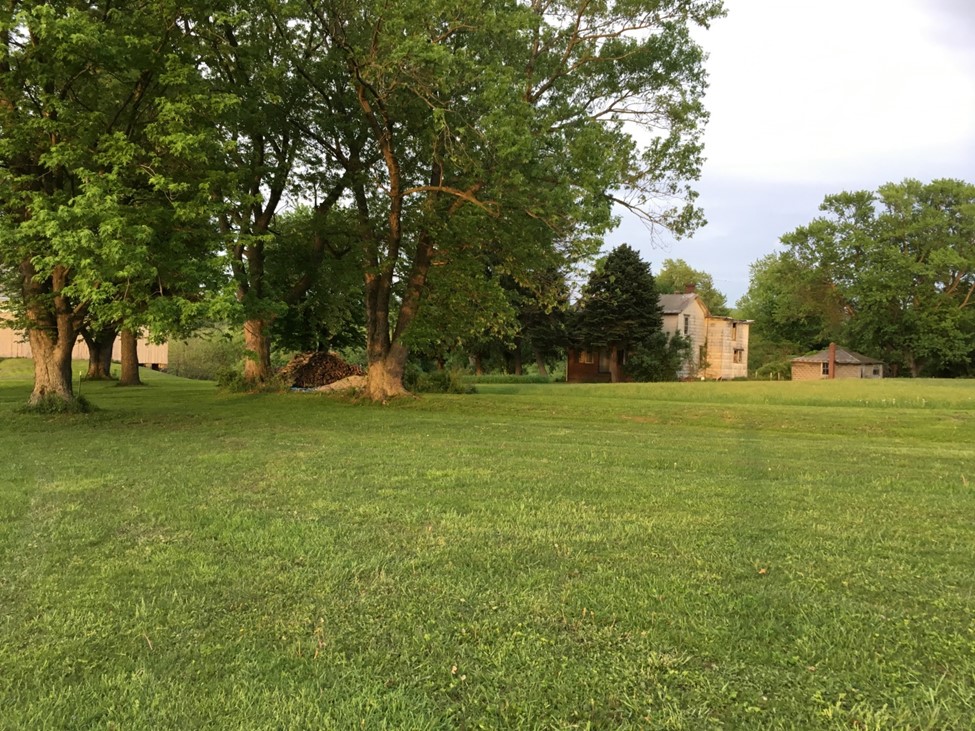
The McCollough and Fiscus families toiled to help each other establish cabins, barns, and clear land for crops. In three years they had made a good start, each clearing a dozen or more acres. But progress would be cut short in 1774. When young John was four, Indian raids raged across the western Pennsylvania frontier and took many white settler’s lives. Most of the raids were perpetuated by Logan, a Cayuga Chief, in revenge for the murder of his family by Virginian settlers. Most of Logan’s raids took place in far southwestern Pennsylvania and not the Westmoreland settlements that allied with Pennsylvania.
The danger was so great that many settlers fled across the mountains to the safety of eastern Pennsylvania. In the late spring of 1774, emergency meetings were held throughout Westmoreland County to petition the Governor of Pennsylvania for assistance. The Fiscus and McCollough families likely attended the meeting at Sheriff John Proctor’s blockhouse located north of the McCollough-Fiscus farms on the Forbes Road.
One of the surviving petitions came from Fort Allen located about six miles south of Hannastown:
Your petitioners in consequence of the first alarm in these parts did assemble at Hannastown, where at their own expense they erected a small fortification as a shelter for their wives and families during troublesome times, and under the direction of the gentlemen of the association voluntarily took up arms for the general defense of this part of the country.
Pennsylvania sent troops to secure the new fort, but they were later ordered away to establish a fort near Kittanning, a major Indian village. Among the Hannastown petitioners was Hannes Spengler, John McCollough’s future father-in-law.
Our McCollough family’s oral tradition was that John’s mother was murdered by a hired hand or in an Indian raid when he was four years old. The 1895 History of Butler County Pennsylvania by the R.C. Brown Company provided the following sketch, likely obtained from interviews with Captain John and Elizabeth’s surviving four daughters:
Captain John McCollough, the progenitor of the family in Butler County, was of Scotch-Irish ancestry, and was born in Westmoreland County, Pennsylvania. His parents were pioneers of that locality and his father a practicing physician. During the absence of the latter from home, his wife was murdered by the hired man, and the cabin burned to the ground. Young John escaped into the woods, and afterwards found a home with a German family, with whom he lived some years and became quite proficient in the German language.
Attorney Newton Clarke McCollough (1864-1925) wrote a lengthy sketch for the first McCollough reunion in 1912 after interviewing Captain John’s surviving grandchildren:
Doctor William McCollough practiced medicine, but on account of the sparsely settled condition of the country spent most of his time away from his home visiting patients. Onde day during his visitations, a band of unfriendly Indians attacked his home, killed his wife and every member of his family except Captain John McCollough, who was then a small boy four years of age, who was out in the field playing and escaped the observation of the Indians. When the doctor returned he found Captain John McCollough crying and running around the ruins of his home, and upon further searching he discovered the bodies of the balance of the family in the ruins. This made him an enemy afterward of the Indians and for many years afterwards he devoted considerable time in making warfare upon them. Nothing is known of his death, or where.
Land records support that the McCollough cabin was on Abraham Fiscus’s 1769 warrant tract located in the remote outskirts of Mount Pleasant Township and far from the protection of Proctor’s Fort (Fort Shippen) located about six or seven miles north on the Forbes Road. On the eve of the Revolutionary War a calamity befell Barbara Fiscus, John’s mother. We can’t say whether she was murdered or died from complications of childbirth or disease. Young John went to live with his German grandparents Magdalena and Gerhart Fiscus on their nearby farm on Nine-Mile Run (now Pleasant Unity). His Fiscus uncles Charles, John, and Abraham, lived on nearby farms. His father, John McCollough, was known to live in the area until at least 1778. We know little about his role in raising his son or where he lived until he appears again in the Westmoreland County records in 1794.
Virginia contested Pennsylvania’s claim on land west of the Allegheny Mountains. John Murray, Earl of Dunmore, and royal Governor of Virginia launched a campaign in October against the Shawnee and Mingo Indians in in the Ohio Country, but also to show that Virginia “owned” Westmoreland County. He led a force of 1,300 men across the Allegheny Mountains from eastern Virginia while Colonel Andrew Lewis moved north with an equal force of militia from the southern Virginia frontier. Their plan was to join forces to attack the Indians far down the Ohio River at Point Pleasant. News of the pending war with Great Britain reached Lord Dunmore on the eve of the battle with the Indians. Historians believed that Dunmore purposely held back his troops and instead exposed Lewis’s militia to a disastrous defeat at the hands of the Indians. Over 200 of Lewis’ militia were killed.
Dunmore retreated to Williamsburg to preserve his army of loyalists, but on the way home the Virginians decided to join the Revolution. Andrew Lewis’s men returned to the Virginia frontier to defend their homes and families against the Indians and the British. By November 1774, an American revolution seemed likely. The Provincial Congress authorized enrollment of 12,000 Minutemen in Connecticut and Massachusetts.
The Fiscus and McCollough families endured many hardships the tumultuous year of 1774. John M’Cologh lost his wife and log cabin. Gerhart and Magdalena Fiscus lost their daughter and assumed the care of their grandson, four-year-old John McCollough. In the late fall of 1774, many Westmorelanders returned to the frontier from the safety of eastern Pennsylvania. They had no livestock or crops in the fields. Stocks of food were dangerously low. The Westmoreland settles shared what they had and subsisted on meager rations of wild game. The winter of 1774-75 was severe and was long known thereafter in western Pennsylvania as the “starvation year.”
 McCollough Family Reunion